For eighteen years, an aging brown bear lived inside a rusted concrete cage no larger than a garage. He had forgotten what grass felt like beneath his paws. He had never climbed a tree, never splashed in a river, and had spent nearly two decades staring through iron bars. When rescuers finally arrived, nobody expected his first reaction.
Eighteen Years Behind Iron Bars
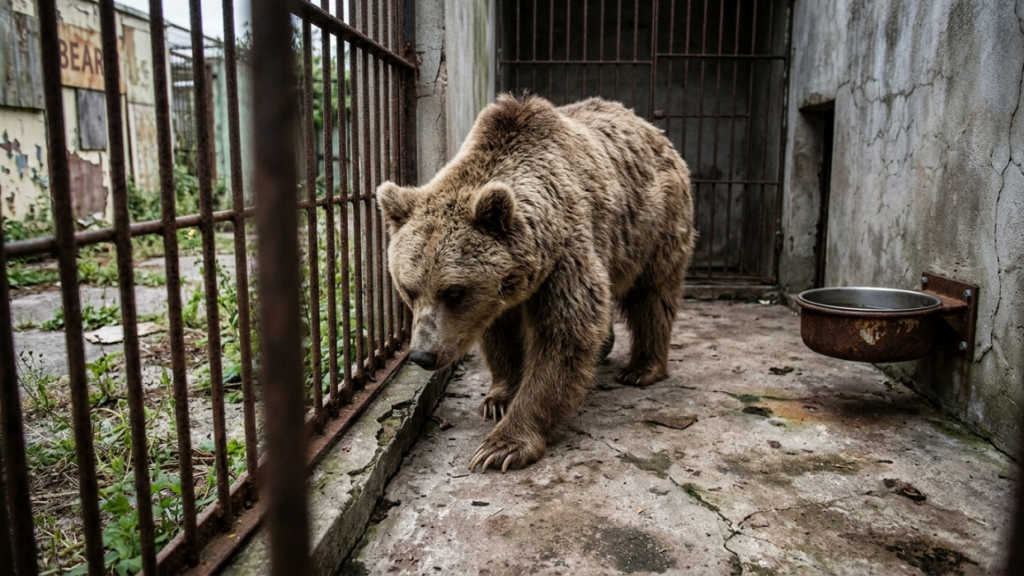
The abandoned roadside zoo had closed years earlier, but one resident had never left.
Hidden behind cracked concrete walls and rusted fencing was an elderly brown bear named Bruno.
His enclosure measured only a few meters across.
There were no trees.
No pond.
No soft ground.
Only cracked concrete stained by years of neglect.
Visitors had long disappeared, yet Bruno remained.
Every morning he walked the exact same path around his cage.
Left corner.
Back wall.
Water bowl.
Front gate.
Then back again.
The pattern never changed.
Animal behavior specialists call this repetitive movement stereotypic pacing, a heartbreaking sign of prolonged psychological stress in captive wildlife.
For Bruno, it had become his entire life.
His claws had grown unnaturally long.
Several of his teeth were badly damaged after years of chewing on steel bars.
His thick fur had become patchy and dull.
Even more heartbreaking…
He no longer reacted when people approached.
It was as if hope had quietly disappeared years before.
When rescue inspectors discovered that Bruno was still alive after eighteen years of isolation, they immediately began organizing what would become one of the largest wildlife rescues the region had ever seen.
Learning That the World Was Bigger Than Four Walls
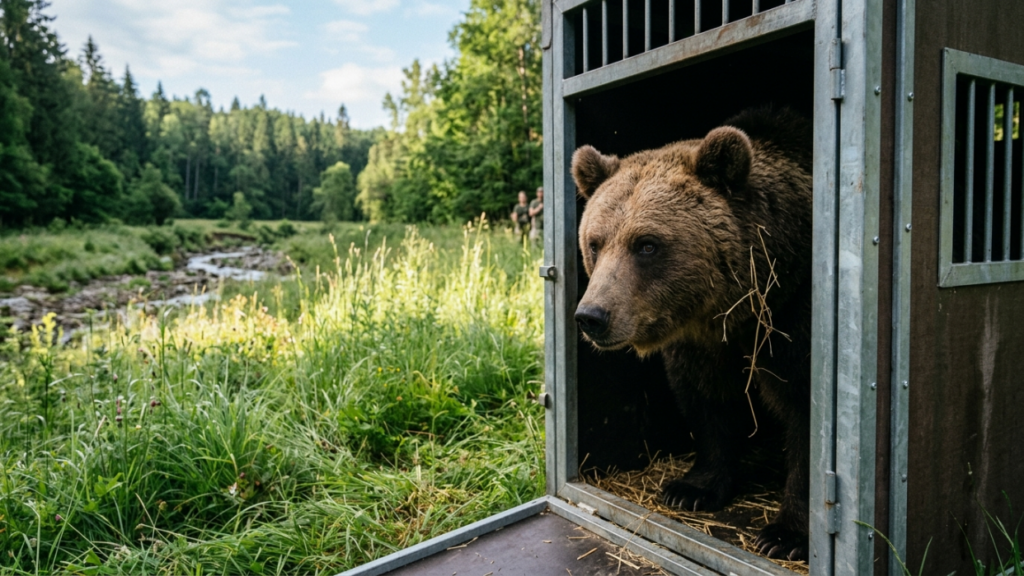
Transporting a 400-kilogram bear required months of planning.
Veterinarians carefully monitored every step to reduce stress during the journey to a wildlife sanctuary nearly six hundred kilometers away.
When the transport crate finally arrived, volunteers stood silently outside the enclosure.
The door slowly opened.
Nothing happened.
Bruno remained inside.
He stared through the opening but refused to move.
Minutes passed.
Then nearly an hour.
For eighteen years, every doorway in Bruno’s life had led only to another cage.
How could he know this one was different?
Eventually, he took one cautious step.
Then another.
His paws touched soft grass for the first time in nearly two decades.
He froze.
Lowering his enormous head, Bruno gently sniffed the ground before lying down in the middle of the meadow.
He rolled onto his back.
Again.
And again.
Caretakers watched quietly as the old bear rubbed his body through the fresh grass, something he had likely never experienced since arriving at the zoo.
Later that afternoon, he discovered a shallow stream flowing through the sanctuary.
Without hesitation, he stepped into the cool water.
Splashing.
Playing.
Drinking.
The volunteers had rescued hundreds of animals over the years.
Many admitted they had never witnessed a moment quite as emotional as watching an old bear discover simple happiness for the very first time.
Freedom Arrived Late—But It Still Arrived
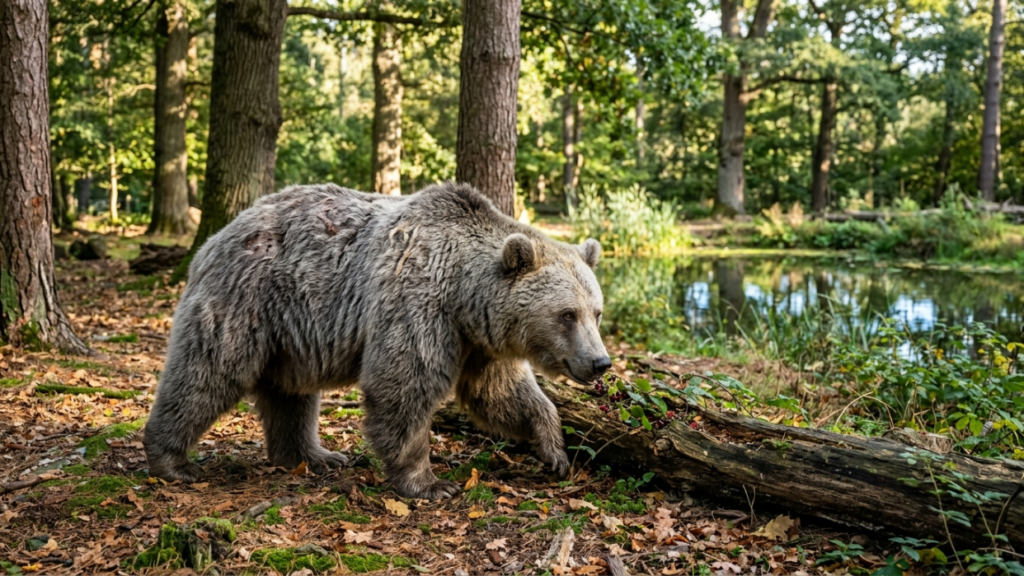
Bruno would never recover the eighteen years stolen from him.
His damaged teeth required lifelong veterinary care.
His joints had developed severe arthritis from decades spent walking on concrete.
He would never return to the wild.
But none of that stopped him from embracing the life he still had.
Over the following years, Bruno explored every corner of his spacious forest habitat.
He climbed fallen logs.
Rested beneath towering oak trees.
Foraged for berries hidden by his caretakers as enrichment.
Spent hot summer afternoons soaking peacefully in the pond.
Visitors often expected to see a sad, broken animal.
Instead, they found a curious old bear enjoying each new day with quiet dignity.
His story inspired stronger animal welfare laws in the region and encouraged authorities to investigate other neglected captive wildlife facilities.
Several additional bears were rescued because of Bruno’s case.
Although he arrived at freedom later than anyone wished, his journey proved something extraordinary.
Rescue is not about giving an animal a perfect past.
It is about giving them the best future still possible.
Bruno spent eighteen years behind iron bars.
Yet the final years of his life were filled with trees instead of concrete.
Birdsong instead of silence.
Open skies instead of steel.
Sometimes freedom comes late.
But for an animal who has waited a lifetime…
Even one day of freedom is worth everything.
