When workers first noticed a small red fox struggling near an abandoned construction site, they thought it was already too late. The tiny cub had become trapped in a pool of sticky industrial tar, unable to move, unable to escape, and too exhausted to cry for help. For three days, rescuers refused to give up on a life that many believed could not be saved.
A Cry No One Heard
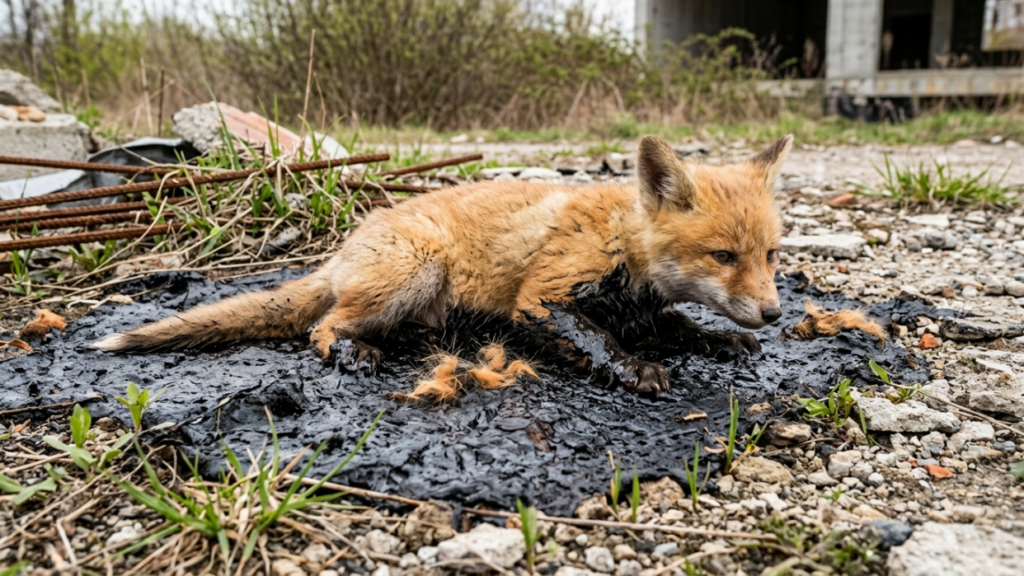
It was early spring when a local maintenance worker spotted what looked like a pile of orange fur near an abandoned construction area on the outskirts of town.
As he walked closer, the heartbreaking truth became clear.
A young red fox cub had become trapped inside a large patch of hardened tar that had been left behind years earlier.
Its tiny paws were completely stuck.
Its tail was glued to the ground.
Even its chest had become coated with thick black tar after hours of struggling to free itself.
The frightened cub had fought so desperately that pieces of fur had been pulled away from its body.
By the time rescuers arrived, it was severely dehydrated and barely able to lift its head.
There was no mother fox nearby.
No den.
No sign that another animal had survived.
The cub was completely alone.
Veterinarians estimated it had likely been trapped for nearly three days without food or water.
Every attempt to pull the cub free by force risked tearing its fragile skin.
The rescue team knew they had only one option.
They would need patience.
A great deal of patience.
A Rescue Measured in Millimeters
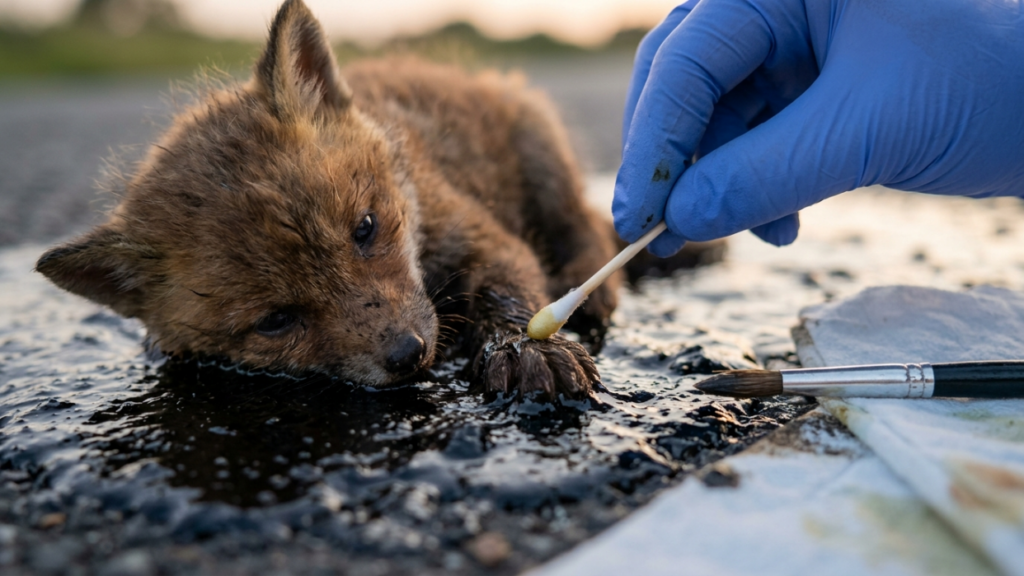
The rescue operation quickly became one of the most delicate wildlife recoveries the team had ever attempted.
Warm vegetable oil was carefully applied to soften the sticky tar without harming the cub’s sensitive skin.
Tiny brushes were used to remove one layer at a time.
Each paw required nearly an hour of careful work.
The fox remained surprisingly calm.
Perhaps it was too exhausted to struggle.
Or perhaps, for the first time in days, it sensed that someone was trying to help.
Volunteers took turns gently supporting its head while veterinarians offered small drops of water through a syringe.
Hours passed.
The sun disappeared.
Portable lights illuminated the rescue site as the team continued working late into the night.
When the cub’s first front paw finally came free, quiet applause spread among the exhausted volunteers.
Another paw followed.
Then the third.
Finally, after nearly twelve hours of continuous work, the little fox was completely free.
But the rescue was far from over.
Its body temperature had fallen dangerously low.
Several paw pads had been badly damaged.
Its fur was still covered with stubborn patches of tar that would require weeks of treatment.
The cub was rushed to a wildlife rehabilitation center where veterinarians worked through the night.
No one knew if it would survive.
Back to the Forest
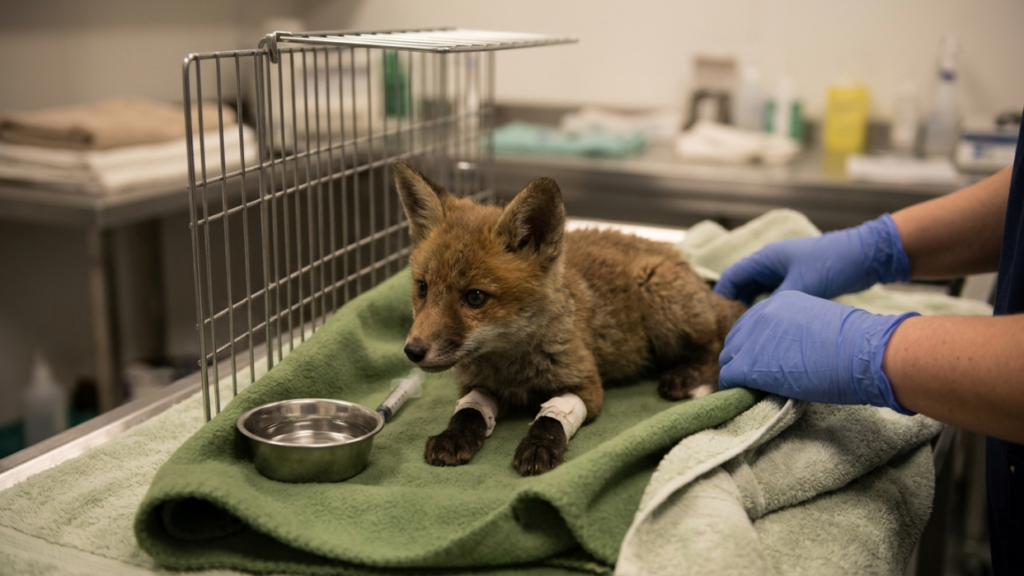
Recovery came slowly.
For the first several days, the fox slept almost constantly while receiving fluids, medication, and carefully prepared meals.
Its damaged paws healed one step at a time.
Fresh fur gradually replaced the patches that had been lost.
As its strength returned, so did its natural curiosity.
Caretakers often found the young fox chasing butterflies inside its rehabilitation enclosure or playfully pouncing on leaves carried by the wind.
It was behaving like a wild cub again.
Exactly as it should.
Nearly three months after the rescue, wildlife experts determined the fox was finally ready to return home.
Before sunrise, the transport crate was quietly placed beside a protected forest where healthy fox populations still thrived.
The door slowly opened.
The young fox hesitated for only a moment.
Then it bounded into the trees without looking back.
Within seconds, it disappeared into the forest.
Only the rustling leaves remained.
For the volunteers, that was the perfect ending.
Wild animals aren’t rescued so they will remember us.
They’re rescued so they can return to the lives they were always meant to live.
The little fox will never know the names of the people who spent three days saving it.
It will never understand how many hands worked together to give it another chance.
And that’s perfectly okay.
Because the greatest reward in wildlife rescue isn’t being remembered.
It’s watching a life that was almost lost disappear safely back into the wild—exactly where it belongs.
